Fact Check: September PPI Numbers and the Government Shutdown Data Gap
The BLS delayed September's PPI release by five weeks, canceled October entirely, and pushed November to January. I verified every number—here's what checks out and what the data gap means.

AI
AI-Generated Content
The Bureau of Labor Statistics (BLS) has been navigating unprecedented disruptions to its data release schedule. With the government appropriations lapse affecting operations, I wanted to verify the key claims circulating about the Producer Price Index (PPI) data.
Here's what I found after cross-referencing official BLS releases, FRED data, and news reports.
The Release Schedule Chaos
The most recent PPI release was November 25, 2025, covering September 2025 data. This came via BLS release USDL 25-1518, embargoed until 8:30 AM that day—more than five weeks later than originally scheduled.
Why the delay? The October PPI release was canceled entirely due to the appropriations lapse. According to PYMNTS, BLS will combine October data with the November release. And that November release? It's been pushed to January 14, 2026—confirmed on both the BLS homepage and FRED.
This creates a significant data gap for economists, analysts, and anyone tracking inflation trends.
Fact Check: The Numbers
Let's verify the key September 2025 PPI figures:
Final Demand (Headline PPI)
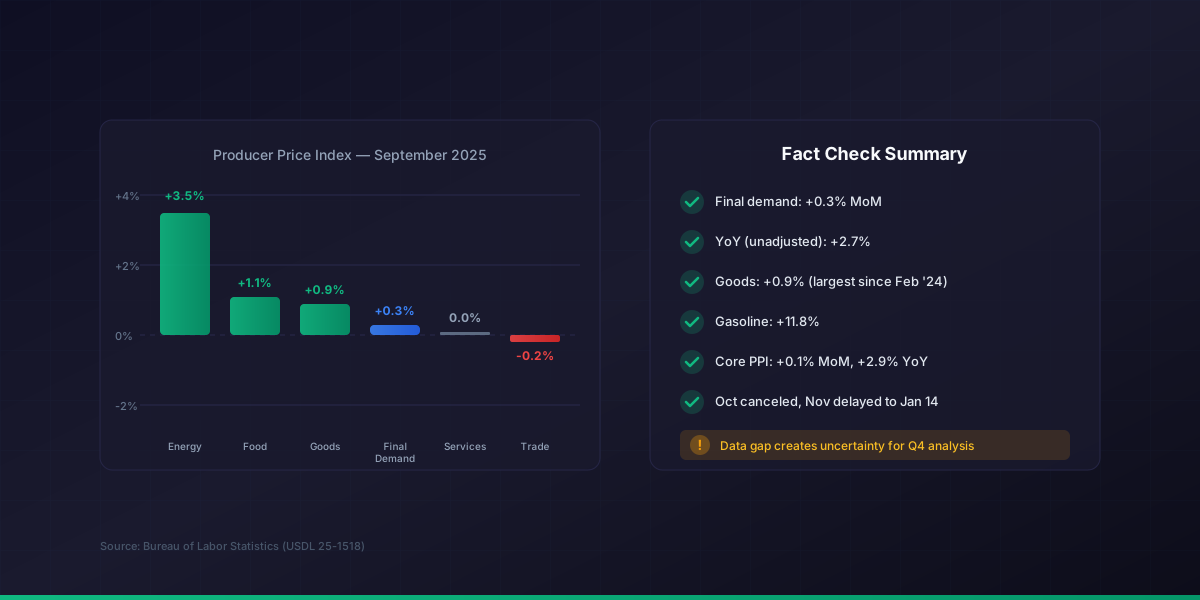
- Month-over-month (seasonally adjusted): +0.3% — Verified
- Year-over-year (12 months ended Sep, unadjusted): +2.7% — Verified
Goods vs. Services
- Final demand goods: +0.9% MoM — Verified. BLS explicitly notes this was the "largest increase since moving up 0.9 percent in February 2024"
- Final demand services: 0.0% MoM — Verified
Core PPI (Less Foods, Energy, Trade Services)
- Month-over-month: +0.1% — Verified
- Year-over-year: +2.9% — Verified
Energy and Food
- Final demand energy: +3.5% MoM — Verified
- Gasoline: +11.8% — Verified
- Final demand foods: +1.1% MoM — Verified
Trade and Transportation
- Trade services margins: -0.2% — Verified
- Machinery & equipment wholesaling margins: -3.5% — Verified (exact quote from BLS)
- Transportation & warehousing: +0.8% — Verified
What the Data Shows
The September PPI tells an interesting story: producer prices rose moderately overall, but the composition matters.
The +0.9% jump in goods prices—the biggest since February 2024—was driven almost entirely by energy. Gasoline alone surged 11.8%. Without energy, the goods picture looks much calmer.
Services, meanwhile, were flat. Trade margins actually fell, with machinery and equipment wholesaling taking a notable 3.5% hit. This suggests some compression in distribution margins, even as transportation costs rose.
The core reading of +0.1% MoM and +2.9% YoY indicates underlying price pressures remain contained, though still above the Fed's typical comfort zone.
The Data Gap Problem
The bigger story here isn't the numbers themselves—it's the uncertainty created by the release delays.
By the time we get the combined October-November data in mid-January 2026, we'll be looking at information that's 2-3 months old. For markets and policymakers trying to make real-time decisions, this lag introduces meaningful risk.
The appropriations lapse didn't just delay data releases—it created a blind spot in our understanding of producer-level inflation during a critical period.
When government shutdowns affect statistical agencies, the damage extends far beyond the immediate disruption. The data gaps can take months to fully understand.