New AI Versions Often Introduce Technical Debt
Each new AI model promises better reasoning and performance, but upgrading introduces hidden costs. Learn when to upgrade and when simplicity wins.

Each new model promises better reasoning, fewer hallucinations, and improved performance.
Unlike traditional software, new AI versions do not simply add features to existing ones. Instead, they change the underlying reasoning mechanisms.
The hidden costs of upgrading
- Prompt structure: A prompt that works reliably in one model version may not perform consistently in the next, making previous strategies unstable or unpredictable.
- Context depth and ordering: As models gain memory capacity, quality may decline due to reduced focus.
- Validation logic: Confirm that the new model understands the intended logic and expected outcomes.
These points highlight the main challenges of upgrading public-facing AI solutions. Rigorous QA processes are essential to prevent security breaches and negative business outcomes.
The case for choosing the simplest model
If ChatGPT-4 delivers adequate results, upgrading may not provide enough improvement to justify the investment.
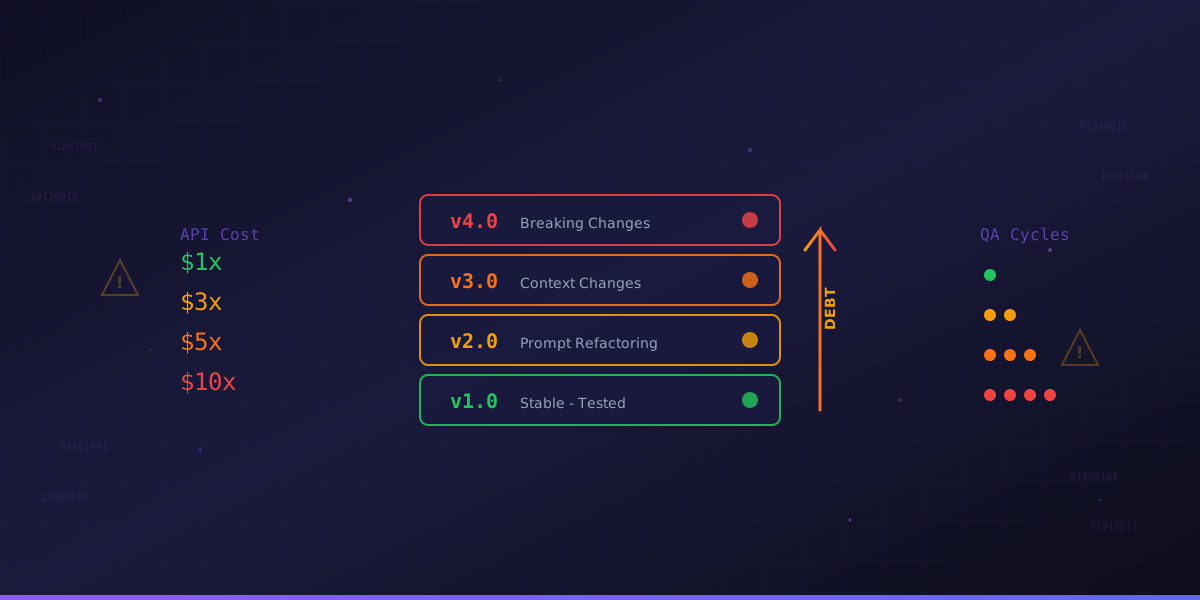
Upgrading incurs immediate costs, including prompt refactoring, context adjustments, regression testing, and additional QA cycles to maintain quality.
For API calls, the costs of new models are typically two to ten times higher.
Approach upgrades strategically
However, new models should not be ignored. Instead, approach them strategically:
- Measure quality using quantifiable KPIs. If the model fails at a task, consider evaluating a higher version.
- Apply new AI versions to different problems or domains as appropriate.
- Avoid forcing a solution onto a problem. Let the problem guide your model selection.
AI success is not determined by using the most advanced model.
Select the most cost-effective, high-quality model that meets your needs with minimal risk. This approach reduces supervision requirements and the likelihood of unexpected issues.
Scale strategically, not aggressively
The most effective AI upgrades scale within your business by strategically applying technology that addresses your specific challenges, rather than relying solely on the latest models.
Topics